
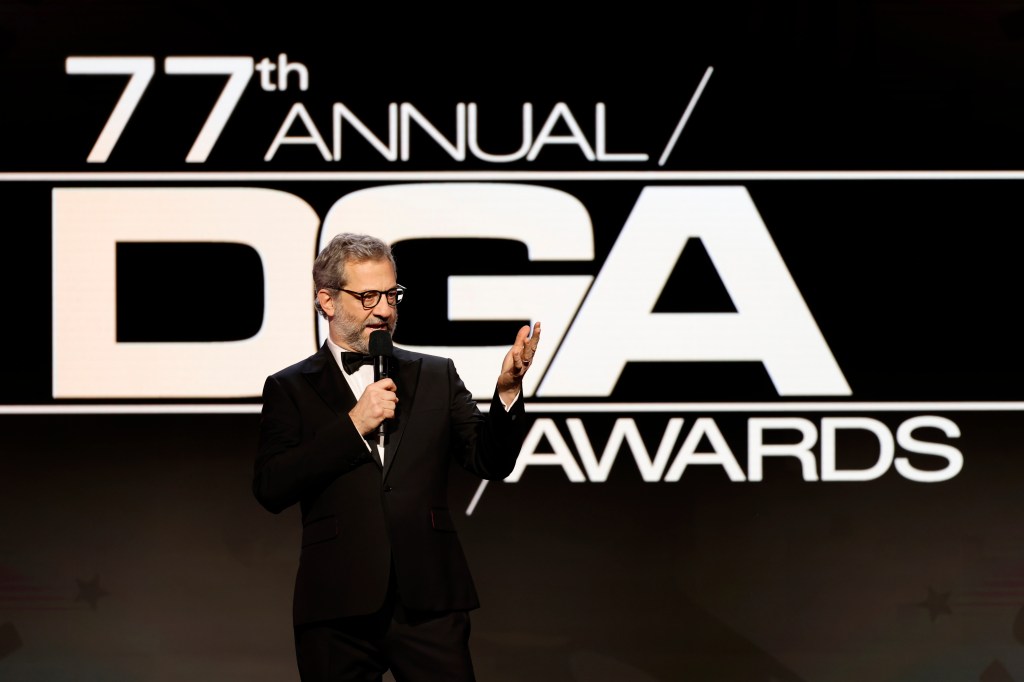
Judd Apatow’s Daring DGA Awards Monologue: A Witty Challenge to Trump and Musk
In a world where comedy often intersects with social commentary, Judd Apatow has once again proven that laughter can be a powerful tool for reflection and change. His recent monologue at the Directors Guild of America (DGA) Awards was not just a showcase of his comedic prowess; it was a daring call to action, blending humor with serious critiques of some of the most controversial figures in contemporary society, namely Donald Trump and Elon Musk. Apatow’s performance urged audiences to adopt a “super double woke” mentality, encouraging self-awareness and accountability in the face of societal challenges.
The Rise of Apatow’s Comedic Commentary
Judd Apatow, known for his work as a director, producer, and writer, has long been recognized for his ability to weave humor with poignant social commentary. His filmography includes hits such as “The 40-Year-Old Virgin,” “Knocked Up,” and “This Is 40,” which not only entertain but often provoke thought regarding relationships, family dynamics, and societal norms.
During the DGA Awards, Apatow’s challenge to Trump and Musk resonated with many, as he deftly blended satire with serious issues, highlighting the absurdities of their actions and ideologies. This approach aligns with a broader trend in comedy where entertainers use their platforms to comment on political and social issues, engaging audiences in meaningful ways.
Apatow’s Unique Approach to Humor
What sets Apatow apart is his ability to balance humor with critique without alienating his audience. His monologue was filled with sharp jabs directed at Trump and Musk, yet it was delivered in a way that invited laughter rather than hostility. This method not only entertains but also encourages reflection on the messages being conveyed.
Apatow’s humor often relies on the following techniques:
- Relatability: He uses everyday experiences to connect with audiences, making his critiques feel accessible.
- Exaggeration: By amplifying the absurdities of his subjects, he highlights their flaws in a humorous light.
- Irony: Apatow often employs irony to underscore the contradictions in political figures’ statements and actions.
Critiques of Trump and Musk
In his DGA monologue, Apatow took aim at Donald Trump, highlighting the former president’s tendency to prioritize self-interest over the well-being of the country. By juxtaposing Trump’s bombastic style with the serious implications of his policies, Apatow not only entertained but also emphasized the need for critical thinking and civic engagement among the audience.
Similarly, Apatow addressed Elon Musk, critiquing the tech mogul’s polarizing influence on social media and public discourse. By poking fun at Musk’s penchant for controversy, particularly on Twitter, he opened up a discussion about the responsibility that comes with such platforms. In a time when misinformation can spread like wildfire, Apatow’s call for a “super double woke” mentality serves as a reminder that we must approach information critically and ethically.
The “Super Double Woke” Mentality
The phrase “super double woke” is indicative of Apatow’s challenge to his audience. But what does it mean? Essentially, it calls for an elevated state of awareness and action regarding social issues. It encourages individuals to not only recognize injustices but to actively participate in addressing them. This mentality is crucial in today’s world, where polarization and division can hinder progress.
Embracing a “super double woke” mindset involves:
- Self-Reflection: Individuals must examine their own beliefs and biases, striving for growth and understanding.
- Engagement: Acting on one’s convictions through advocacy, activism, or simply informed discussions.
- Empathy: Recognizing the humanity in others, even when opinions differ, fostering dialogue rather than division.
The Impact of Comedy on Social Issues
Apatow’s daring DGA Awards monologue highlights the vital role that comedy plays in shaping public discourse. Comedians have historically used humor to address serious topics, from political satire to social justice. Apatow’s approach is a testament to this tradition, showcasing how laughter can bridge gaps and challenge the status quo.
This intersection of comedy and social consciousness has several benefits:
- Accessibility: Humor makes complex issues more relatable and easier to digest.
- Engagement: A comedic approach captures attention and sparks conversations that might not occur in a traditional setting.
- Reflection: Comedy encourages audiences to think critically about their beliefs and the world around them.
Comedy as a Reflection of Society
Moreover, Apatow’s monologue serves as a mirror reflecting societal tensions. In a time when political discourse can often feel heavy and divisive, humor provides a necessary respite, allowing for critical engagement in a more palatable form. By addressing figures like Trump and Musk, Apatow not only entertains but also encourages audiences to confront uncomfortable truths.
Conclusion: The Future of Comedy and Consciousness
Judd Apatow’s daring DGA Awards monologue stands as a significant contribution to the conversation about the role of comedy in society. By challenging figures like Trump and Musk with wit and intelligence, he has opened the door for deeper discussions about accountability and social consciousness.
In a world that often feels chaotic and divided, embracing a “super double woke” mentality is more important than ever. Apatow’s performance exemplifies how comedy can be a catalyst for change, urging individuals to reflect, engage, and act. As we move forward, it is crucial for entertainers and audiences alike to recognize the power of humor in shaping our collective future, fostering a culture that values both laughter and responsibility.
See more CNET Live